I'm going to be helping my friend Brad do some breeding bird atlas survey work down in southern Ohio this weekend. He arranged for free camping, which is a nice bonus. Hopefully, I'll get some more state year birds as well - I'm having an average year for the state list, but my best year ever for the ABA area - which is partly why my state list is suckin'!
We're going to stop in Pickaway County on the way down tomorrow to try for Black Rails that may have set up shop in a local wetland - at least two males and perhaps a female have been calling all week. Of course, with my luck, it will be gone by the time I get there...
Thursday, June 5, 2008

Tuesday, June 3, 2008
Florida Trip, Day 6: May 16

Willet, Fort Desoto State Park
The Last Day
After a fine day in the Gulf of Mexico, our last day in Florida was devoted to a bit of “mop-up” and then some time in the Tampa/St. Petersburg area. First off, we arose very early in the morning and headed back to Miami in search of Spot-breasted Oriole and White-winged Parakeet, both of which we had missed on Monday but had gotten some tips about good locations. We ended up back in the same neighborhoods, just at more likely times. We spent nearly 2 hours searching. An oriole was heard but never seen at our first location, which also featured Monk Parakeets and Yellow-chevroned Parakeets. Our target birds were not present, but a great bonus prize was an Eastern Screech-Owl that flew up and perched in a tree right in front of me! After two hours, we gave up on our target birds. We were stopped at a light right before the freeway ramp, ready to head north and west, when John yelled out “Oriole! It flew into that tree!” We all whipped our heads around and while not the best views in the world, there was a Spot-breasted Oriole, perched up in the top of a palm! It flew off, and our light turned green. Our mood of defeat was turned to triumph, and away we went, life bird number 415 safely ticked.
We made it to Fort DeSoto State Park about 1pm, a place known for shorebirds and as a location for Black-hooded Parakeets. We did not find the parakeets, but some careful scrutiny of shorebirds revealed an American Oystercatcher (ABA bird 383 for me) and a Snowy Plover (ABA 384, life bird 416)! After an hour and a half at the park, we followed some directions in Bill Pranty’s guide to a marina in St. Pete, and we drove around for a bit until we heard the screeching of parrots. We found a house with platform feeders and Monk Parakeets, along with a Snowy Egret in a pine tree and a Great Egret on their deck.
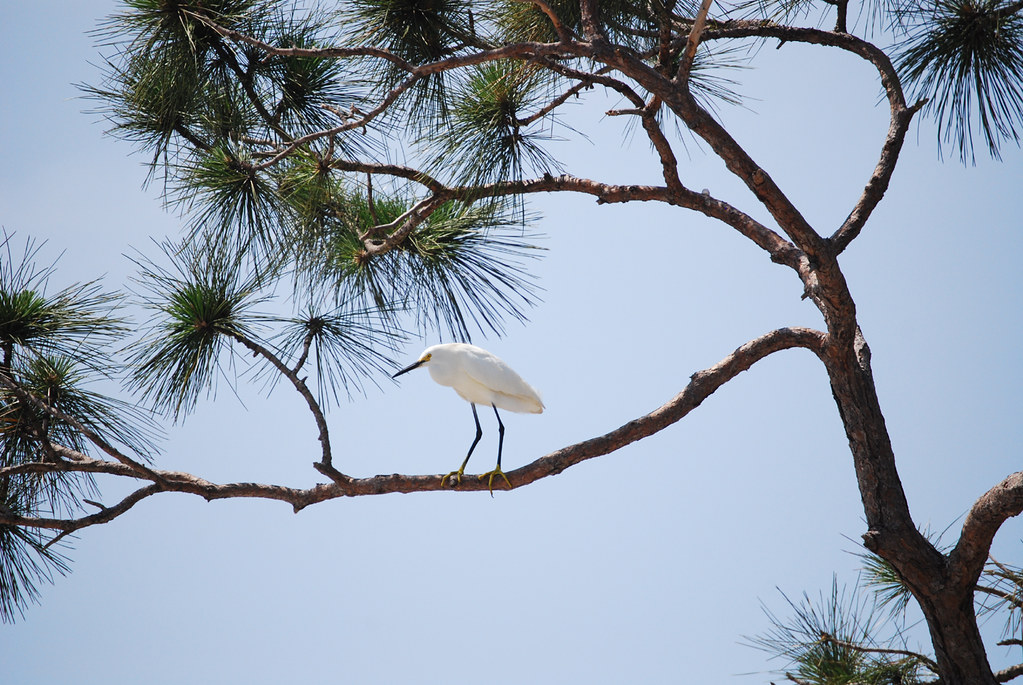
Snowy Egret, pretending to be a Pine Warbler
Suddenly, a big parakeet dropped down onto a platform feeder, and there it was – Black-hooded Parakeet, a recent addition to the ABA list, and now the most recent addition to my lists (ABA 385, life 417)! This was a big, good looking bird, and pretty vocal – this was the parakeet we heard that drew us to this location. The parakeet was also the only bird of the trip that was a life bird for everyone.
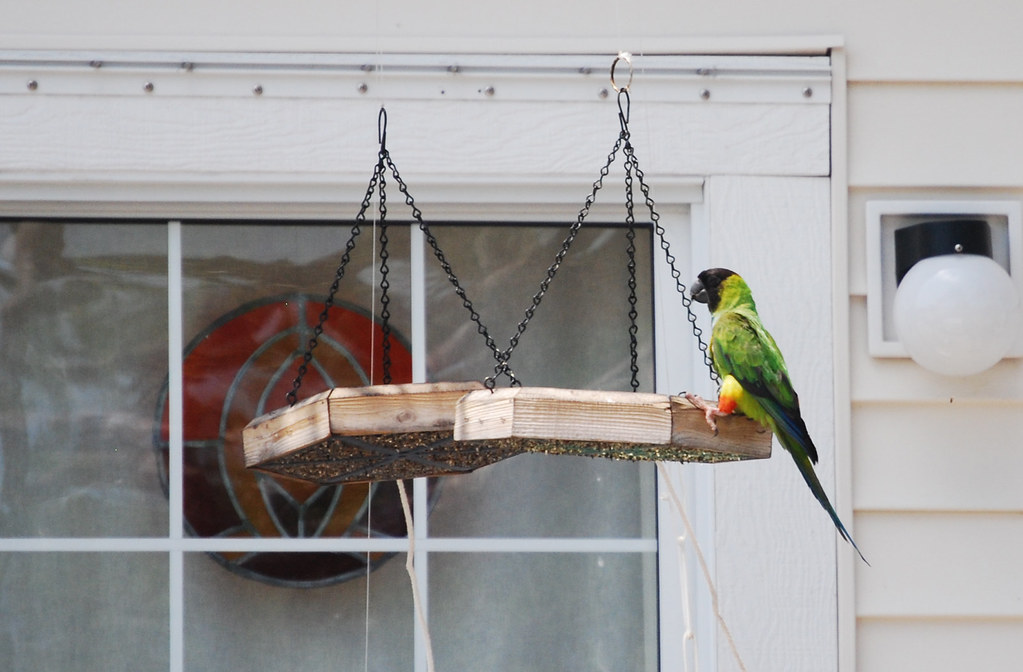
Black-hooded Parakeet, St. Petersburg
We headed north again, towards Hernando Beach and possibly the last place in Florida where there is an established population of wild Budgerigars, or Budgies. For a typical noisy psittacid, these guys were difficult to find, and we spent two and a half hours driving around a sleepy retiree neighborhood until, just as we were about to give up, a small flock flew overhead and perched in some bushes. This was our last target bird and closed out our trip, as we decided to head home a day early. I finished up the trip with a life list totaling 418 and an ABA list of 386, an increase of 46 birds. Overall, the trip was highly successful, with around 180 species observed and hitting almost all of our target birds, minus Greater Flamingo, White-tailed Kite, Cape Sable Seaside Sparrow, Red-crowned Parrot, White-winged Parakeet, and Fulvous Whistling-Duck.
Friday, May 30, 2008
Florida Trip, Day 6: May 15

Birding The Dry Tortugas
We left our hotel before dawn on the 15th and drove down to Key West to catch our ferry to the Dry Tortugas, the Yankee Freedom II. The boat was crewed by merry sailors, including the boat's tour guide, Tortuga Jack, who resembled the unlikely combination of Santa Claus and Luke Skywalker. The trip out to the Tortugas takes about two and a half hours, and allowed for a bit of pelagic birding along the way. Birds were infrequently seen until we got closer to our destination, but the ones we saw were pretty much all life birds for me (with the exception of the Brown Pelicans): Brown Booby, Audubon's Shearwater, and Bridled Tern. When the Dry Tortugas were in visual range, another couple of life birds were spotted, Brown Noddy and Masked Booby, and then we docked at Garden Key, amazed at the swarms of Sooty Terns and Brown Noddies in the air.
 Huge swarm of terns

Brown Noddies on the coal dock
 Magnificent Frigatebird

Brown Noddy


Cattle Egret looking for frail neotropical migrants to snatch up

Female Black-throated Blue Warbler
 Scope Patrol
After some time, we finally picked out a juvenile Black Noddy from the surrounding Brown Noddies. This was a bird that was very subtle in its differences from its compatriots, being only slightly smaller, with a slightly longer bill. The bird also had some scalloping visible on the upperwing coverts, which was what first drew our attention to the bird. The white cap on its head was fairly bright, but to be honest, I couldn't really say in the bright sunlight that it was any more brilliant than a Brown Noddy's head. Still, the differences were real, and there was a fine life bird in the scope.
Satisfied with our Black Noddy, we left the battlements and headed back out to the dock, determined to find our Red-footed Booby. We set up the scopes again, and scanned the masses of nesting and roosting Magnificent Frigatebirds on Long Key. Finally, the bird was found! Perching with some frigatebirds on a dead tree, this was a juvenile Red-footed Boobie, which stood out from the black frigatebirds through its sandy plumage. Patient scrutiny through the scope was rewarded with views of the booby's distinctive bluish-gray, dagger-shaped bill, although it was too distant to make out leg color. No other booby features this color combination, so we were confident this was the bird. Success!
 Masked Boobies on Hospital Key
Satisfied, we boarded the ferry and headed back to Key West, with a pause to examine the Masked Boobies nesting on Hospital Key, the only location in the United States where they do so. On the way back, I scanned and scanned the ocean, hoping for tropicbirds or even a Cory's Shearwater, but no more life birds for me today. Still, scanning was rewarding, as I saw a loggerhead turtle swimming at the surface and numerous flying fish. Only as we neared Key West did I realize one thing: I had forgotten to put any sunscreen on the back of my calves!
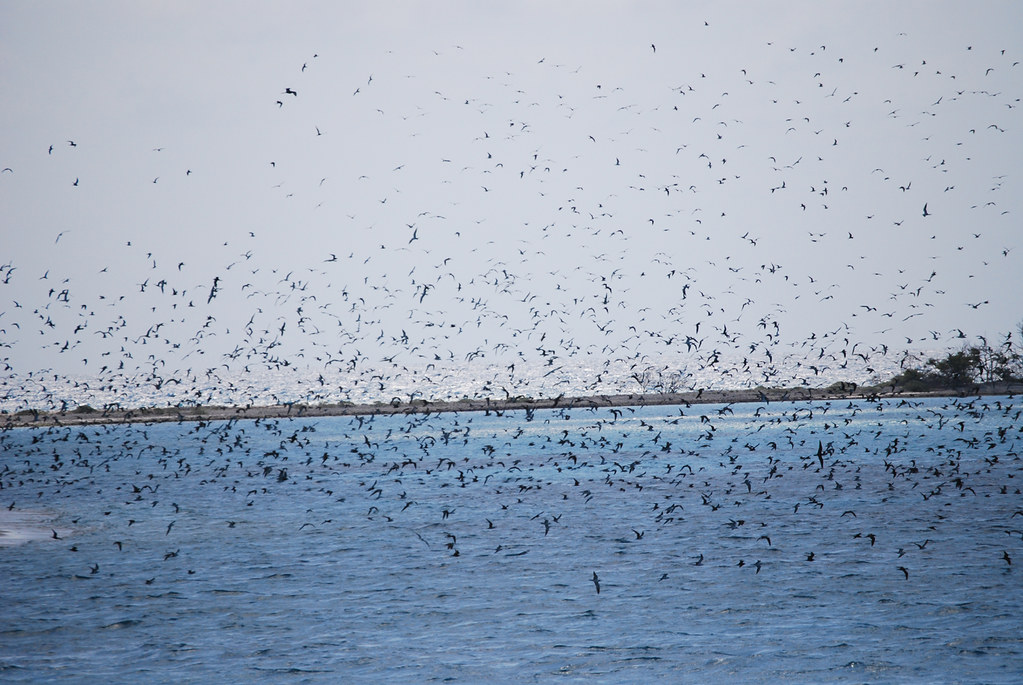 Huge swarm of terns
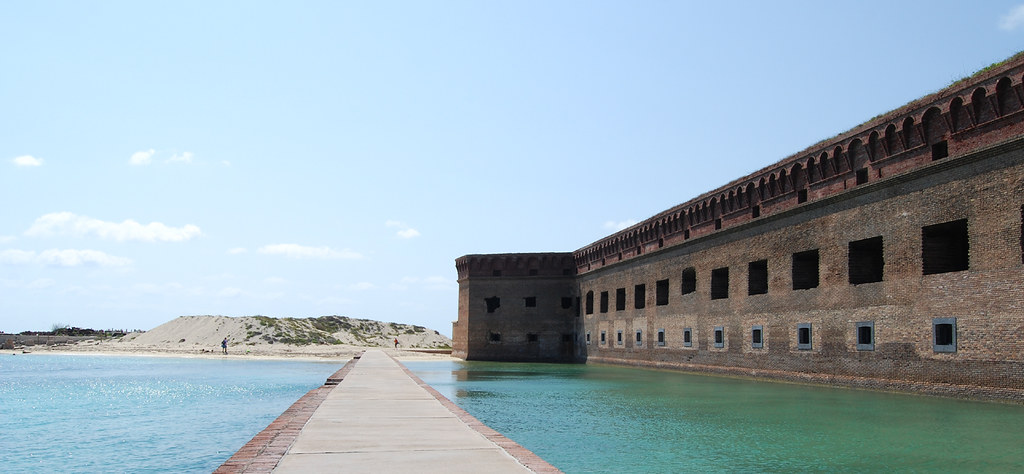
Garden Key is home to Fort Jefferson, an antebellum US fort built with some 16 million bricks, which covers nearly the entire key. It's quite the interesting structure, and it's amazing to think about all the labor it took to transport the building materials and then build the fort in such a remote and inhospitable location.

Our first order of business was to attempt to locate our two target birds: Black Noddy and Red-footed Booby, both of which had been reported recently. We set up scopes near the coal dock and spent some time scanning all the Brown Noddies, but no luck. We did add Indigo Bunting to our trip list at this point, though, and I got some decent photos of noddies and Magnificent Frigatebirds. We then set up on the dock next to the ferry and scanned Long Key for the Red-footed Booby, and again, no luck. We did have some nice company in the form of Ruddy Turnstones scurrying about our feet, though. Then it was time for lunch aboard the ferry (make your own sandwiches).
Our first order of business was to attempt to locate our two target birds: Black Noddy and Red-footed Booby, both of which had been reported recently. We set up scopes near the coal dock and spent some time scanning all the Brown Noddies, but no luck. We did add Indigo Bunting to our trip list at this point, though, and I got some decent photos of noddies and Magnificent Frigatebirds. We then set up on the dock next to the ferry and scanned Long Key for the Red-footed Booby, and again, no luck. We did have some nice company in the form of Ruddy Turnstones scurrying about our feet, though. Then it was time for lunch aboard the ferry (make your own sandwiches).
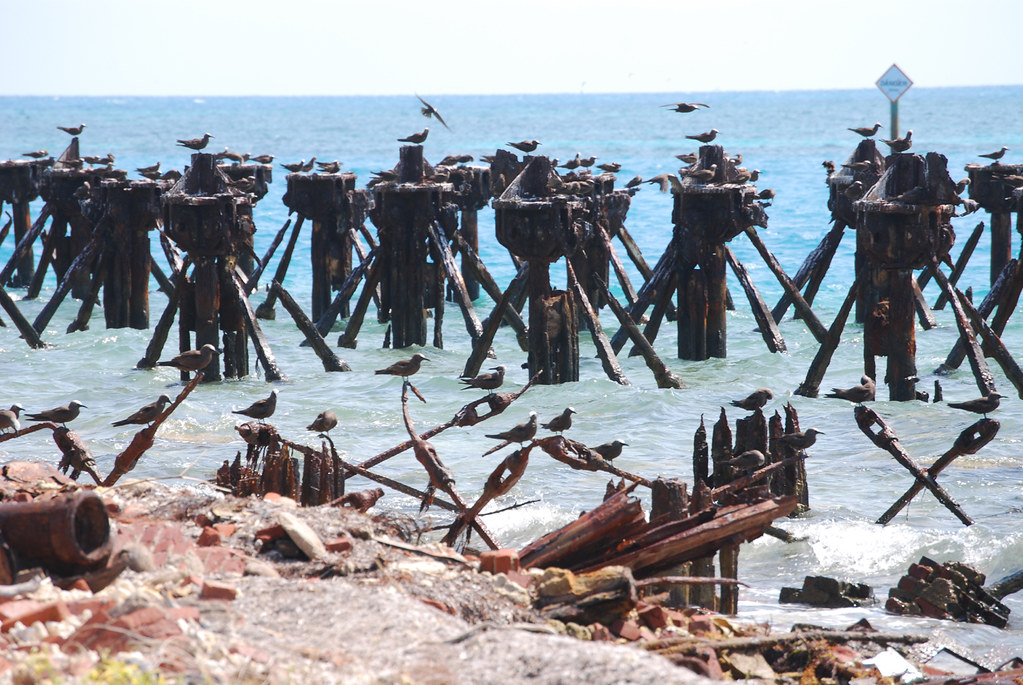
Brown Noddies on the coal dock
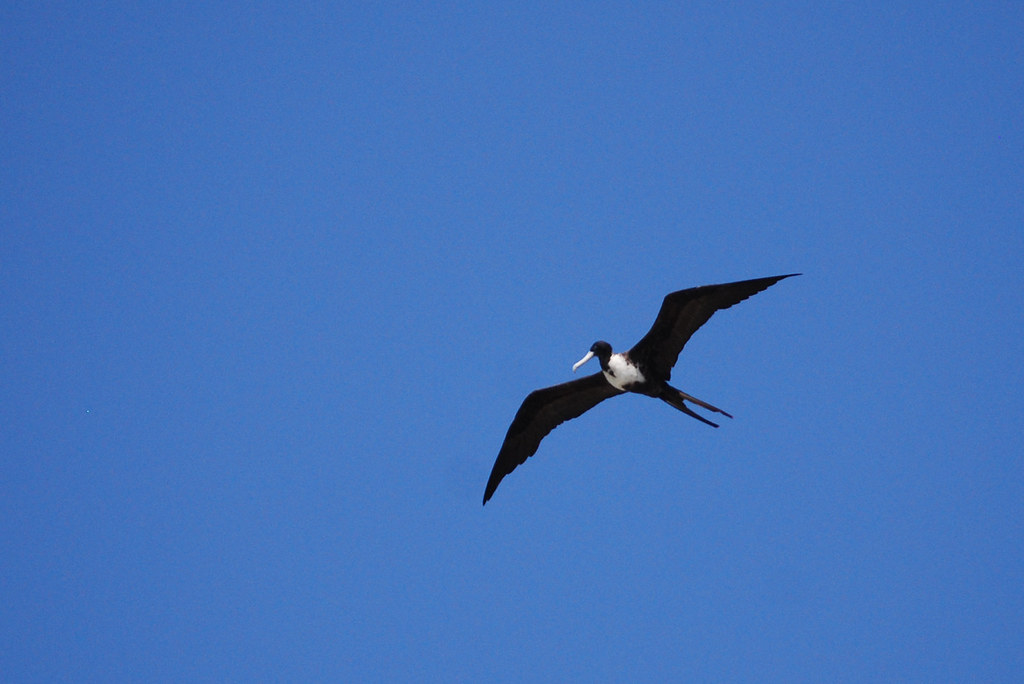 Magnificent Frigatebird
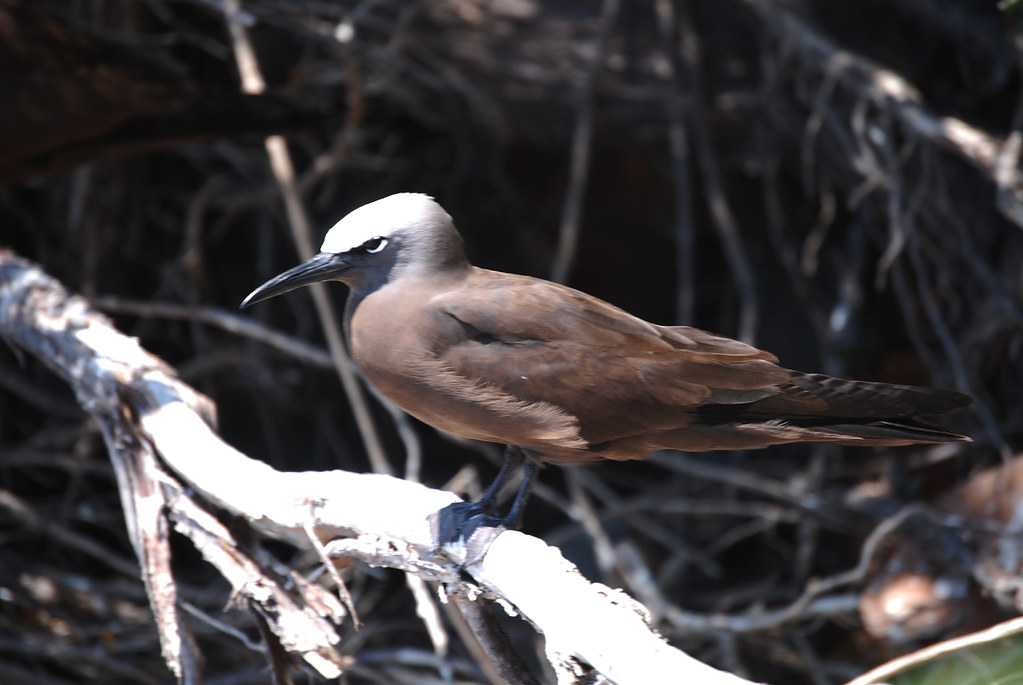
Brown Noddy
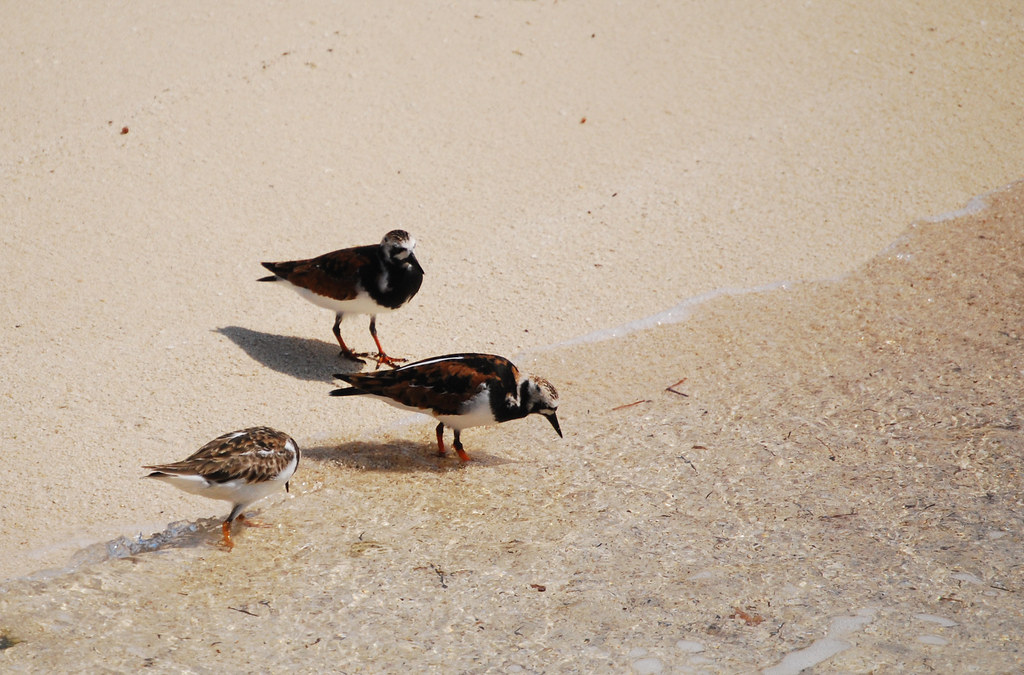
Ruddy Turnstones
After lunch, a few of us explored the fort a bit while those with scopes went up to the top battlements, as a park ranger helpfully pointed out that we'd get a great view of the entire coal dock from a higher vantage point. While exploring the interior, I was able to imagine what the place must look like after a major fallout - and imagination was all I had, since this late in May, there were few migrants present. Birds present within the fort included Yellow-billed Cuckoos, American Redstarts, Common Yellowthroats, Blackpoll Warblers, and a female Black-throated Blue Warbler that caused some initial confusion, due to it's skulking about in the interior of a bushy tree and its odd field marks: an overly bold supercilium and an extremely faint wing patch. Cattle Egrets were stalking about, and Barn Swallows swooped over head. After surveying the grounds, I headed up to join the scope patrol.
Cattle Egret looking for frail neotropical migrants to snatch up
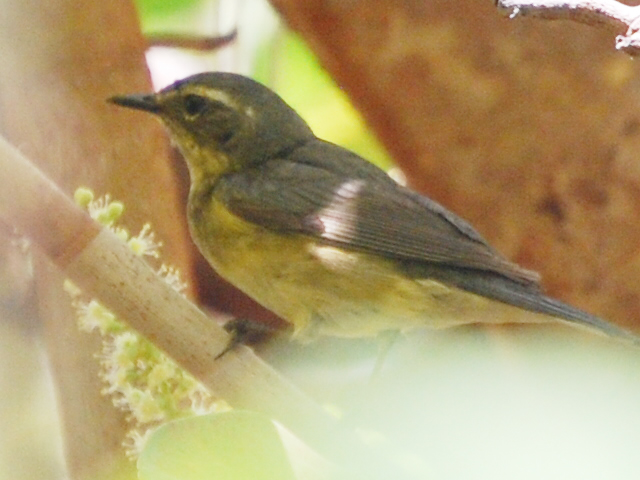
Female Black-throated Blue Warbler
 Scope Patrol
After some time, we finally picked out a juvenile Black Noddy from the surrounding Brown Noddies. This was a bird that was very subtle in its differences from its compatriots, being only slightly smaller, with a slightly longer bill. The bird also had some scalloping visible on the upperwing coverts, which was what first drew our attention to the bird. The white cap on its head was fairly bright, but to be honest, I couldn't really say in the bright sunlight that it was any more brilliant than a Brown Noddy's head. Still, the differences were real, and there was a fine life bird in the scope.
Satisfied with our Black Noddy, we left the battlements and headed back out to the dock, determined to find our Red-footed Booby. We set up the scopes again, and scanned the masses of nesting and roosting Magnificent Frigatebirds on Long Key. Finally, the bird was found! Perching with some frigatebirds on a dead tree, this was a juvenile Red-footed Boobie, which stood out from the black frigatebirds through its sandy plumage. Patient scrutiny through the scope was rewarded with views of the booby's distinctive bluish-gray, dagger-shaped bill, although it was too distant to make out leg color. No other booby features this color combination, so we were confident this was the bird. Success!
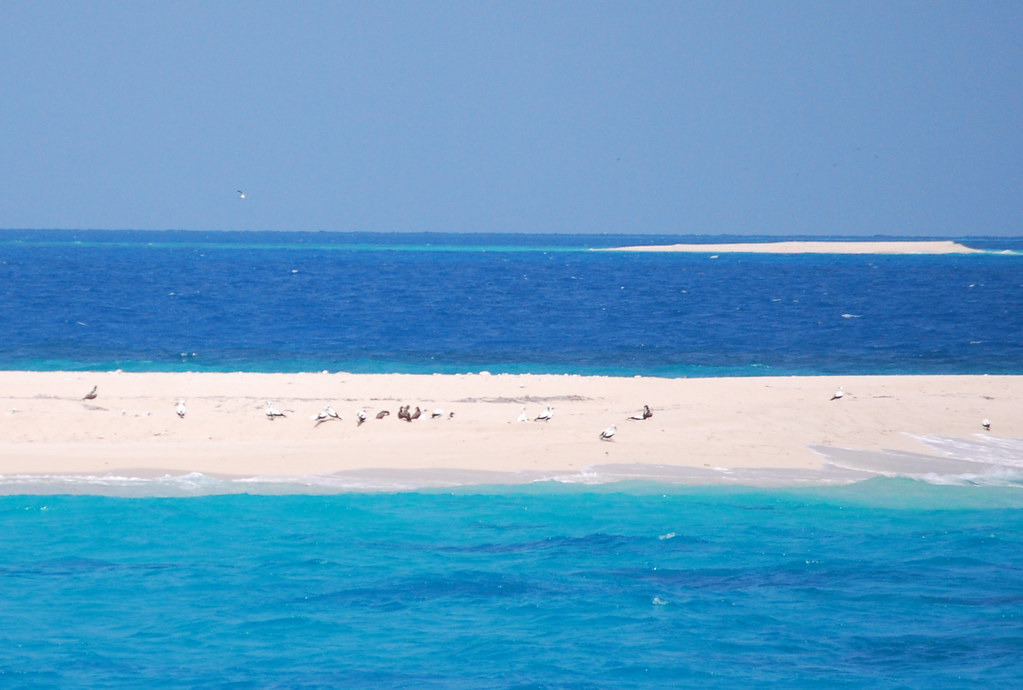 Masked Boobies on Hospital Key
Satisfied, we boarded the ferry and headed back to Key West, with a pause to examine the Masked Boobies nesting on Hospital Key, the only location in the United States where they do so. On the way back, I scanned and scanned the ocean, hoping for tropicbirds or even a Cory's Shearwater, but no more life birds for me today. Still, scanning was rewarding, as I saw a loggerhead turtle swimming at the surface and numerous flying fish. Only as we neared Key West did I realize one thing: I had forgotten to put any sunscreen on the back of my calves!
Thursday, May 29, 2008
Florida Trip, Day 5: May 14
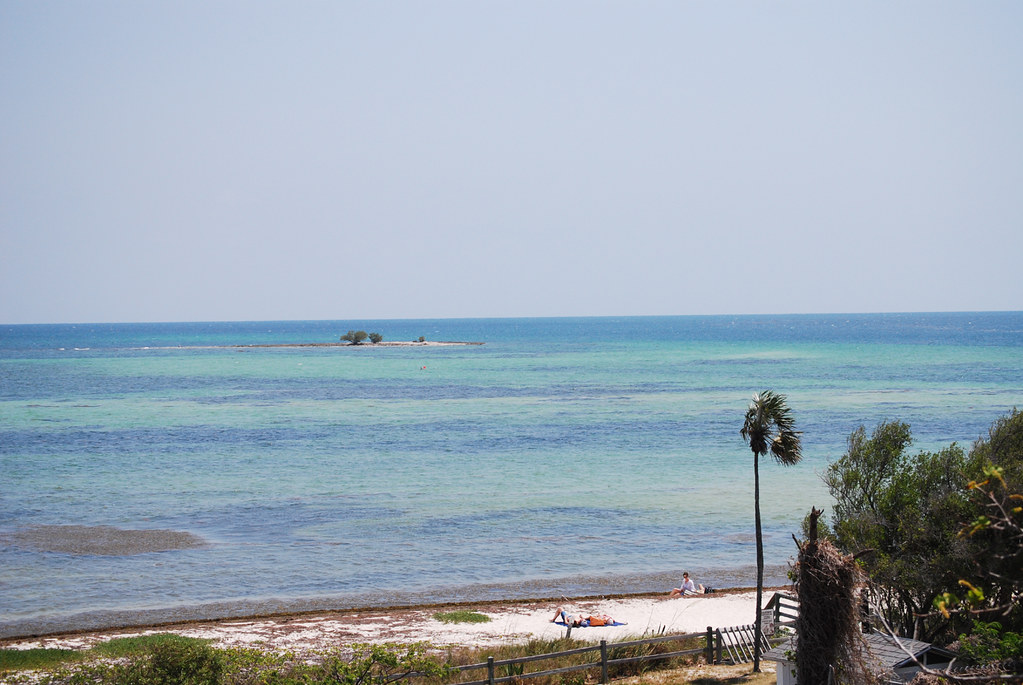
Birding the Florida Keys
Wednesday was spent exploring some local birdy spots in the Florida Keys and going after certain target birds. We hit locations on Key Largo, Big Pine Key, Lower Matecumbe Key, and Vaca Key. The morning started at Dagny Johnson Key Largo Hammock Botanical State Park, where we picked up another Mangrove Cuckoo, had great looks at a Black-whiskered Vireo, and I had my life White-crowned Pigeon. Otherwise, it wasn’t really too birdy, with the only new bird (besides the pigeon) a Blackpoll Warbler.
We then made our way down to Vaca Key and the town of Marathon, and hit a local golf course for Burrowing Owl ( a lifer) and visited a state office building complex that had Least Terns and Roseate Terns nesting on the roofs. We waited in the heat for a while, and finally had a pair of Roseate Terns show up (another lifer). After that, we decided to have lunch at a great local spot, Herbie’s. I highly recommend it.
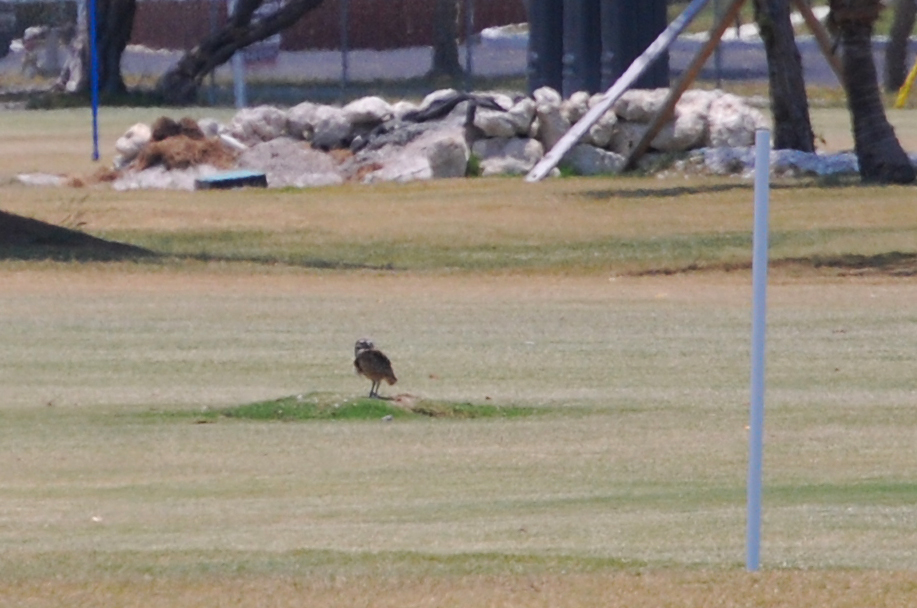
Burrowing Owl, Marathon
After lunch, it was on to Bahia Honda Key, which is a state park. Not much of interest there besides girls in bikinis, but I did get some good scenery photos and decent photos of Blackpoll Warblers.
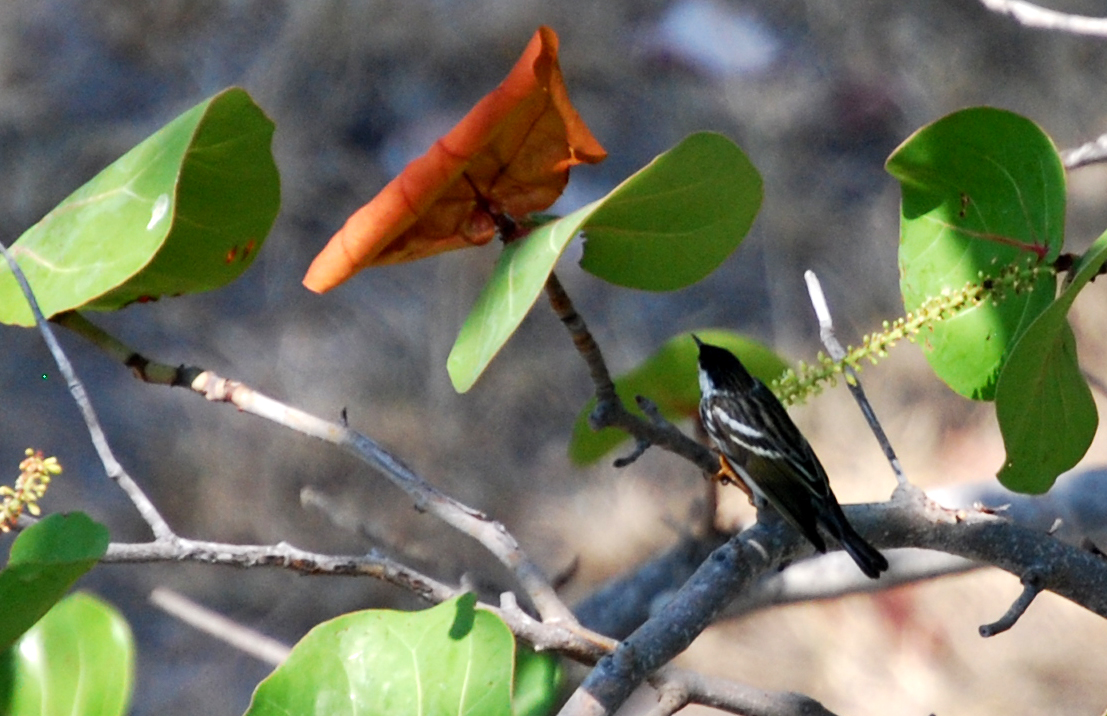
Blackpoll Warbler, Bahia Honda Key
We ended up in Big Pine Key and searched vainly for a motel that wasn’t charging $100 a night for a 2 bed room with no phone, but alas. This motel did have a pool, but it was being used by Common Grackles and Eurasian Collared Doves, so any desire for a refreshing dip was quelled.
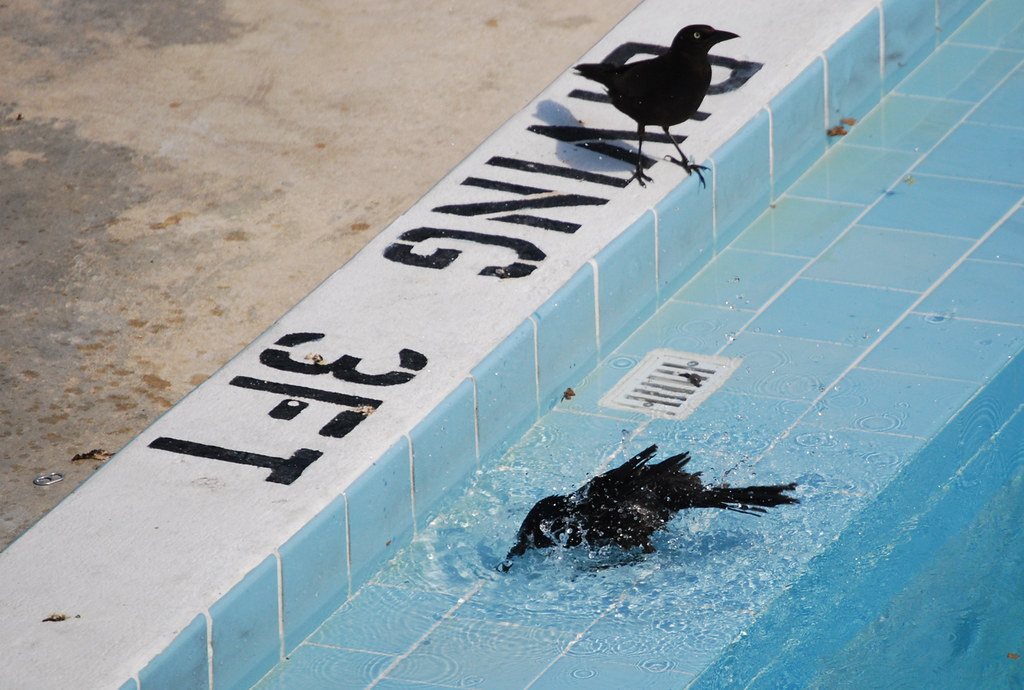
Common Grackles using the pool, Big Pine Key
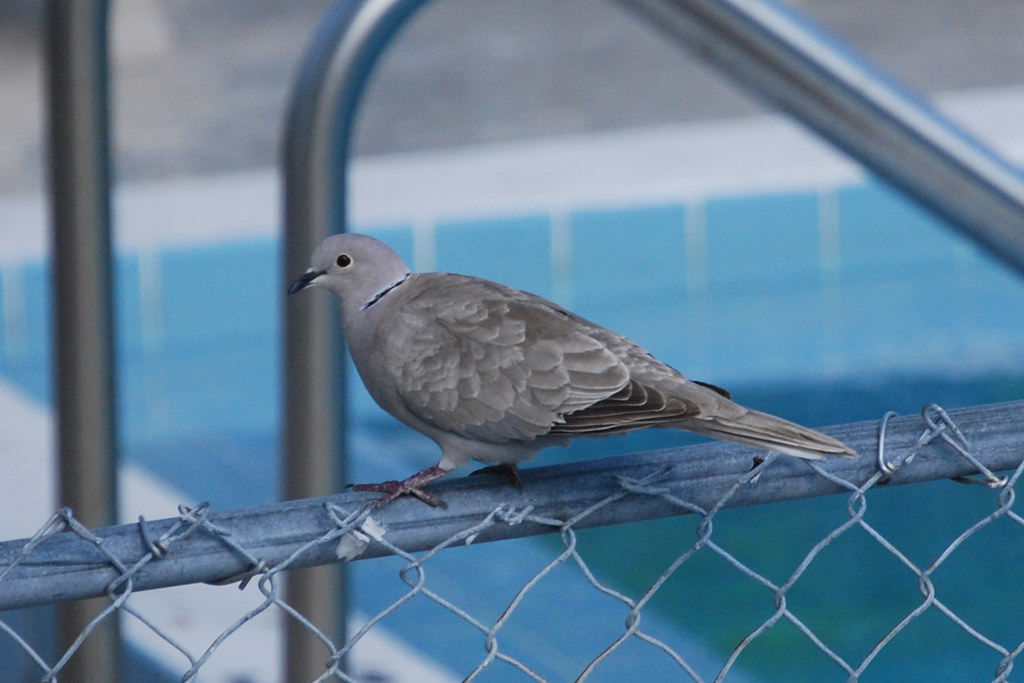
Eurasian Collared Dove, contemplating a dip
After a dinner of Cuban food, we drove back up to the Marathon Airport and camped out on a picnic table on the south side, awaiting dusk and my last life bird of the day – Antillean Nighthawk. Then it was back to the hotel, eagerly anticipating tomorrow’s destination: The Dry Tortugas!
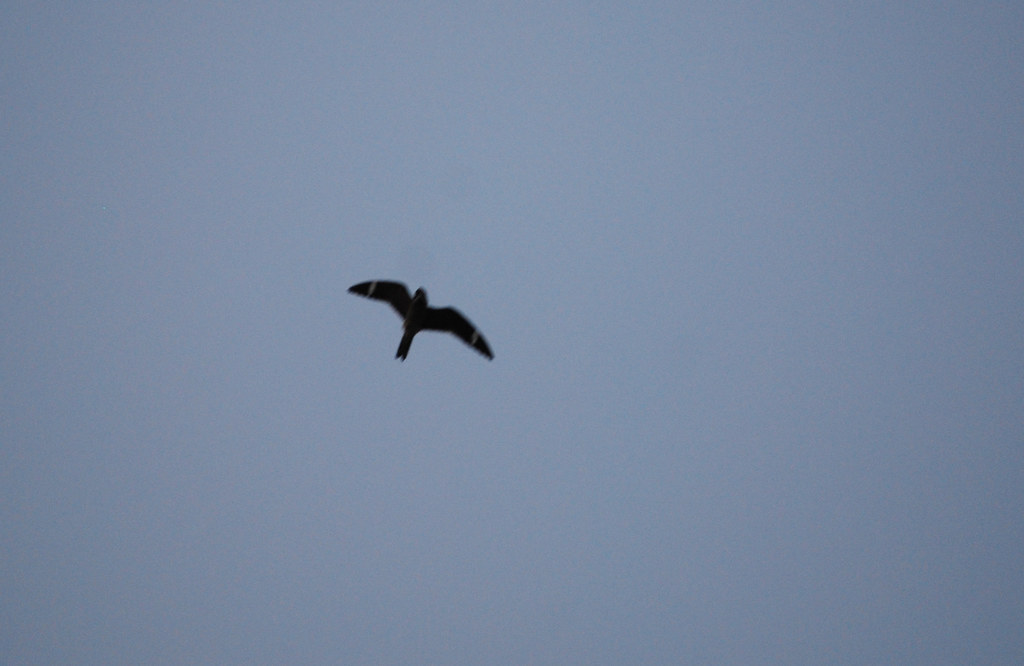
Antillean Nighthawk
Wednesday, May 28, 2008
Florida Trip, Day 4: May 13
A Day in the Everglades


The fourth day of our trip was devoted to birding the Florida Everglades. We spent nearly 12 hours in the National Park and racked up a good amount of birds, although we dipped on a couple I had hoped to see.
Our first stop was at Royal Palm , normally a great spot for waders, but not today. It was a great stop for gators, though, as I counted at least 18 individuals along the raised boardwalk.I did get a good photo of the Florida subspecies of Red-Shouldered Hawk (B. lineatus extimus) and an artsy-fartsy shot of a Black Vulture.

Red-Shouldered Hawk

Black Vulture

We stopped along the road near Mahogany Hammock, a location in past years that was good for Cape Sable Seaside Sparrow. We didn't see or hear the sparrow, but we had a fantastic fly-by from a pair of Swallow-tailed Kites, and got some close looks at Lubber Grasshoppers.

Swallow-tailed Kites
We then hit Mahogany Hammock, where we heard our first Black-whiskered Vireo (an ABA bird for me). On the way out from the hammock, one of our group pointed out a raptor and said "Snail Kite! No, I mean Swallow-tailed..." But I got my binoculars on it and said "No, it really IS a Snail Kite!!" We stopped the car and watched it hunt for a bit, then noticed another Snail Kite perched in a low tree. So we had a pair, male and female. Then another Snail Kite flew in, and another, and... In the end, we had THREE pairs of Snail Kites hunting the same field! A great life bird at 401!
 Snail Kite
We stopped at the West Lake area to use the bathroom. In the lake, we noticed two crocodiles, which was pretty neat. As we were headed out of the parking lot, a Mangrove Cuckoo flew over, and began calling in the trees. A life bird for a few of us, but I had it in Puerto Rico a couple years ago. Still, great to get it on the ABA list!

Then, it was time for Snake Bight. The trail out to the bight is notorious among North American birders as being one of the most mosquito-infested places on the continent. Accordingly, we prepared by wearing long-sleeved shirts and even brought head nets. It turns out we barely needed them, as drought conditions and perhaps storm damage have resulted in lower numbers of skeeters. We didn't really need our head nets, but I wore mine anyway since it kept the skeeters that were there from buzzing my ears. At the end of the trail, we set up scopes and peered into the heat haze for something, anything pink. No luck. The Greater Flamingos weren't there at all. A bonus prize for me, however, was a Clapper Rail (lifer 402) and Wilson's Plover (lifer 403). Another treat was finding a Great "White" Heron on the way out - the white morph of Great Blue Heron that only occurs in Florida.
Having been disappointed on the flamingos, we then stopped at Flamingo for microwaved burgers and beer. While eating lunch, we enjoyed the company of a crow who was waiting for us to be careless with our food. We also added Laughing Gull and Northern Rough-winged Swallow to our trip list, and I spotted an American White Pelican soaring with a Turkey Vulture, a great trip bird! After lunch, we hit the visitor's center (unmanned) and noted a developing sand spit in the bay, making a note to stop back and check it out for shorebirds later. We then hit the campground in search of Shiny Cowbirds, and checked out Eco Pond, which before Hurricane Andrew was a great roost for waders, but had been pretty well damaged. Still, we got our only American Avocet of the trip here. We then headed back to the visitor's center to scope the sandbar, where I noticed a flock of cowbirds. We scanned them, and I found a Shiny Cowbird among them, and added another species to my ABA list. Then we spent some time scoping the now-well developed sandbar, which held a number of birds, including Osprey, Black-bellied Plover, Short- and Long-billed Dowitchers, Stilt Sandpiper, Ruddy Turnstone, Willet, Dunlin, Forster's Tern, Least Tern, and a pair of Royal Terns (yet another bird for the ABA list). We then headed out of the park, hoping for a White-tailed Kite, but no such luck.

Black-necked Stilt and American Avocet
Overall, a pretty good day. I gained three life birds and four ABA-area birds, but we dipped on Greater Flamingo, Cape Sable Seaside Sparrow, and White-tailed Kite. Not too bad!
Our first stop was at Royal Palm , normally a great spot for waders, but not today. It was a great stop for gators, though, as I counted at least 18 individuals along the raised boardwalk.I did get a good photo of the Florida subspecies of Red-Shouldered Hawk (B. lineatus extimus) and an artsy-fartsy shot of a Black Vulture.

Red-Shouldered Hawk

Black Vulture

American Alligator
We stopped along the road near Mahogany Hammock, a location in past years that was good for Cape Sable Seaside Sparrow. We didn't see or hear the sparrow, but we had a fantastic fly-by from a pair of Swallow-tailed Kites, and got some close looks at Lubber Grasshoppers.

Swallow-tailed Kites
We then hit Mahogany Hammock, where we heard our first Black-whiskered Vireo (an ABA bird for me). On the way out from the hammock, one of our group pointed out a raptor and said "Snail Kite! No, I mean Swallow-tailed..." But I got my binoculars on it and said "No, it really IS a Snail Kite!!" We stopped the car and watched it hunt for a bit, then noticed another Snail Kite perched in a low tree. So we had a pair, male and female. Then another Snail Kite flew in, and another, and... In the end, we had THREE pairs of Snail Kites hunting the same field! A great life bird at 401!
 Snail Kite
We stopped at the West Lake area to use the bathroom. In the lake, we noticed two crocodiles, which was pretty neat. As we were headed out of the parking lot, a Mangrove Cuckoo flew over, and began calling in the trees. A life bird for a few of us, but I had it in Puerto Rico a couple years ago. Still, great to get it on the ABA list!

Then, it was time for Snake Bight. The trail out to the bight is notorious among North American birders as being one of the most mosquito-infested places on the continent. Accordingly, we prepared by wearing long-sleeved shirts and even brought head nets. It turns out we barely needed them, as drought conditions and perhaps storm damage have resulted in lower numbers of skeeters. We didn't really need our head nets, but I wore mine anyway since it kept the skeeters that were there from buzzing my ears. At the end of the trail, we set up scopes and peered into the heat haze for something, anything pink. No luck. The Greater Flamingos weren't there at all. A bonus prize for me, however, was a Clapper Rail (lifer 402) and Wilson's Plover (lifer 403). Another treat was finding a Great "White" Heron on the way out - the white morph of Great Blue Heron that only occurs in Florida.
Having been disappointed on the flamingos, we then stopped at Flamingo for microwaved burgers and beer. While eating lunch, we enjoyed the company of a crow who was waiting for us to be careless with our food. We also added Laughing Gull and Northern Rough-winged Swallow to our trip list, and I spotted an American White Pelican soaring with a Turkey Vulture, a great trip bird! After lunch, we hit the visitor's center (unmanned) and noted a developing sand spit in the bay, making a note to stop back and check it out for shorebirds later. We then hit the campground in search of Shiny Cowbirds, and checked out Eco Pond, which before Hurricane Andrew was a great roost for waders, but had been pretty well damaged. Still, we got our only American Avocet of the trip here. We then headed back to the visitor's center to scope the sandbar, where I noticed a flock of cowbirds. We scanned them, and I found a Shiny Cowbird among them, and added another species to my ABA list. Then we spent some time scoping the now-well developed sandbar, which held a number of birds, including Osprey, Black-bellied Plover, Short- and Long-billed Dowitchers, Stilt Sandpiper, Ruddy Turnstone, Willet, Dunlin, Forster's Tern, Least Tern, and a pair of Royal Terns (yet another bird for the ABA list). We then headed out of the park, hoping for a White-tailed Kite, but no such luck.

Black-necked Stilt and American Avocet
Overall, a pretty good day. I gained three life birds and four ABA-area birds, but we dipped on Greater Flamingo, Cape Sable Seaside Sparrow, and White-tailed Kite. Not too bad!
Thursday, May 22, 2008
Florida trip, Day 3: May 12
Exotics in Miami
 Monk Parakeet at Nest, Miami
We started bright and early in Miami by returning to the neighborhood we had the Yellow-chevroned Parakeets in the night before. Sure enough, the parakeets were back, and joined by Monk Parakeets (life bird 398), Red-Masked Parakeets and Red-Mitred Parakeets. Of these, only Monk Parakeets are on the ABA/Florida state list so far, although from their abundance, I can't imagine that Yellow-chevroned Parakeets will be unlisted for too much longer. We searched for a Spot-breasted Oriole as well, but no luck. Monk Parakeet at Nest, Miami

Red-masked Parakeets (lower left) and Red-mitred Parakeets
We headed over to the Kendall neighborhood near a Baptist hospital that is normally a psittacid hotspot, but no parakeets or parrots were to be found, a recurring theme for the day. Parakeets were in short supply, and we'd only see Monk and Yellow-chevroned Parakeets at a couple locations in Miami. I did pick up Red-Whiskered Bulbul (#399) in this neighborhood, though, and got a cute picture of a Muscovy Duck and her brood.

Mama Muscovy and her 13 kids
We headed out towards Matheson Hammock next, stopping for Burger King and gas first. While we were filling up, I looked out the front window at the BK drivethrough and there was a Common Myna - which ended up being my 400th life bird. Not what I would have liked, but I'll take it. In the palms at the drivethrough was a Gray Kingbird building a nest, a new ABA bird for me, so a good consolation prize for a dubious 400th bird.

My 400th life bird - a @#$% Common Myna at Burger King!
The goal at Matheson Hammock was Mangrove Cuckoo, and we thought we had one. A cuckoo showing a dark mask was observed, and when it flew off, no rufous showed in the upper wings. However, when the bird flew again, it did show some orangish color in the underwings. So, we figured this was just a Yellow-billed Cuckoo. I did get my ABA-area Magnificent Frigatebird here, though, so not a total wash.
We ended the birding day at Cutler Ridge, where we pulled off to observe the nesting Cave Swallows, another ABA bird for me. Then it was on to Homestead for the night and the best motel of the trip, the Fairway Inn - affordable, nice pool, clean and comfortable. I recommend it as a good base for the Everglades and upper Keys.
Wednesday, May 21, 2008
Florida trip, Day 2: May 11
Our first destination on Sunday, May 11, was a location in Polk County that was known for nesting Short-tailed Hawks. We arrived there about 8:30, having added White-winged Dove to my ABA list along the way and seeing some Wild Turkeys as well. We waited a while, meeting up with another birder who had driven out from Arizona, and ticking off Tufted Titmouse, Pine Warbler and Northern Parula for our trip list, all the while scanning through kettles of vultures for a smaller, dark raptor. Finally, at 9:30 AM, a dark morph Short-tailed Hawk soared over head, my first life bird of the day!

Short-tailed Hawk
We then headed off to Lake Arbuckle State Forest, where the Arizona birder had seen mating Limpkins the night before at the campground. We did in fact get our only good Limpkin (life bird #394) sighting of the trip here, as one was poking around the weeds and walking about the shore. We were treated to more great views of Swallow-tailed Kites and Red-shouldered Hawks as well. Then it was on to the state forest in search of pine woods specialties. We did a bit of searching in the woods, which were fairly quiet. We finally managed to get a Bachman's Sparrow to respond to a tape (#395) and headed south towards Miami, bidding farewell to the Arizona birder.

Limpkin
 Bachman's Sparrow
On the way over to the Florida Turnpike, I saw a Crested Caracara being harassed by smaller birds - not a great look at 60mph but good enough for an ID and number 396 on the list! We made a stop in Palm Beach County at the Wakodahatchee Wetlands, and got a load of great photos of Purple Gallinule, Tri-colored Heron, Great Blue Heron, and Common Moorhen, among others.

Purple Gallinule

Tri-Colored Heron
After the thrill of close-up experiences with wading birds at Wakodahatchee, we headed into Ft. Lauderdale to find the breeding Smooth-billed Anis, which were nesting in a low-income neighborhood just south of the airport. We had no luck at first, so we cruised the airport looking for the birds and possibly burrowing owls (picking up Muscovy Duck, life bird 397, which is countable in Florida, even though it's the duck equivalent of Rock Pigeon), then went back to the neighborhood, where a helpful and friendly resident told us that they were being seen routinely at 7pm. So, off to dinner at Quizno's to kill time, and then back to the ani spot. We parked, got out and started scanning. A dark, grackle-sized bird flew up behind us into some trees, and I thought "probably a grackle, but better look at it" and voila! there's the bird! I thought at the time it was a life bird, but have since recalled that I had seen it in Puerto Rico (for some reason I was recalling the Puerto Rican anis as Groove-billed, but they don't occur there). We had some great looks at the bird, which was carrying food, and then headed south again to Miami. Along the way, a Hill Mynah flew across the highway, but it's not a countable bird right now.

Smooth-billed Ani
We hit the parrot/oriole spot near the Miami airport once we got in, and did see some (uncountable) Yellow-chevroned Parakeets and found some Monk Parakeet nests, but no "quakers" were there. So, we drove around trying to find an affordable and non-crappy hotel, finally settling on a Sleep Inn after deciding we wouldn't find anything for less than $100 a room. This would be the only hotel with a coffee maker we would stay in. The following day was to be devoted to Urban Birding: parrots and Spot-breasted Oriole were our targets.
Subscribe to:
Posts (Atom)